
Europe is still among the most desirable locations where international jobseekers would find employment owing to the good economies, high labor standards, competitive wages, and high quality of life. Ranging from technology and health care to logistics, warehousing, hospitality and manufacturing, labor shortages still abound in the European countries which present actual challenges of skill and semi-skills to the labor force.
Nonetheless, locating the correct employment in Europe does not entirely revolve around just posting on the internet. The awareness about European job market, employer demands, company policies, labor laws and visa policies will significantly contribute to achieving stable employment and long-term career development. This is an all-encompassing guide that every jobseeker must have prior to initiating his or her job search process in Europe.
Understanding the European Job Market
Europe has a wide range of job opportunities in the technological sector, healthcare sector, finance sector, tourism sector, logistics sector, and manufacturing sector. Germany, the UK, France, the Netherlands, and Sweden are some of the countries characterized by good economies, good salaries, and professional working conditions. The applicants have to align their skills with the local demand:
| Sector | High-Demand Countries | Typical Roles |
|---|---|---|
| Technology & IT | Germany, Netherlands, UK | Software Developer, Data Analyst, IT Support |
| Healthcare | Germany, France, Sweden | Nurse, Medical Technician, Physician |
| Tourism & Hospitality | Spain, Italy, Greece | Hotel Staff, Tour Guide, Event Planner |
| Logistics & Warehousing | Netherlands, Germany, Belgium | Forklift Operator, Warehouse Supervisor, Transport Manager |
| Finance & Banking | UK, Switzerland, Germany | Accountant, Auditor, Financial Analyst |
When in the right country with the right skillset it can take a very short time to get the job.
Key Company Policies to Expect
It is necessary to comprehend general company policies which are applicable to the staff when applying for positions in Europe:
- Working Hours and Work-Life Balance
Work-life balance is the first priority in Europe. Commonly, the working weeks are from 35 to 40 hours, and in many countries, there are legal restrictions on overtime. For instance, France has a law for a 35-hour workweek while Germany is encouraging flexible hours. Moreover, workers get a lot of paid vacation, between 20 and 30 days per annum, and in addition, the offices are often closed on public holidays. - Employment Contracts and Worker Rights
In most of the European countries, there is a necessity for written contracts of employment to be drawn up in detail containing salary, working hours, responsibilities, and benefits. Employee rights have strong protection that includes sick leave, parental leave, and protection against unfair firing. In several areas, trade unions are instrumental in the process of employment conditions being worked out. - Equal Opportunity and Diversity Policies
Equality and diversity are the main points in the European workplaces. Discrimination on the ground of gender, age, race, religion, disability, or sexual orientation is prohibited by law. A great number of companies and organizations work hard to make their environments inclusive and also run programs that support minorities or women in leadership positions. - Health and Safety Regulations
Europe is an area where health and safety regulations are very tough. All workers no matter what sector they are in can expect nothing less than safe working conditions; those conditions might include ergonomic workstations, mental health support and safety measures put in place particularly in the case of construction or manufacturing.
Tips for Jobseekers
- Study Company Culture: To understand company culture, it would be effective for you to check reviews posted by people on Glassdoor and LinkedIn websites. Both would offer you insights into whether workers have a good balance of life and what kind of management and workers benefit from there.
- Prepare for Structured Interviews: If you are applying for a job in Europe, be prepared to face a series of interviews. Make sure you are on time for your interviews.
- Understand Your Contract: It is important to review all contracts and clarify all queries with regard to the terms of the contract, salary, probation period, and notice period.
- Visa Requirements Proof: The employees who are not from the EU needs to verify if the visa requirement is applicable for the specific country he/she is traveling to. Certain countries offer an express visa facility for professionals.
- Adjust to the Local Working Conditions: Communication style, business dress code, and working behavior vary greatly depending on the region. Adaptability and care with these matters go a long way.
Europe’s Growing Logistics and Warehouse Sector
The logistics of Europe is in full blast with major centers that are located in Rotterdam Hamburg, Antwerp, and Duisburg. Experts familiar with inventory control programs, automatic systems and route optimization are very much demanded. Salary ranges:
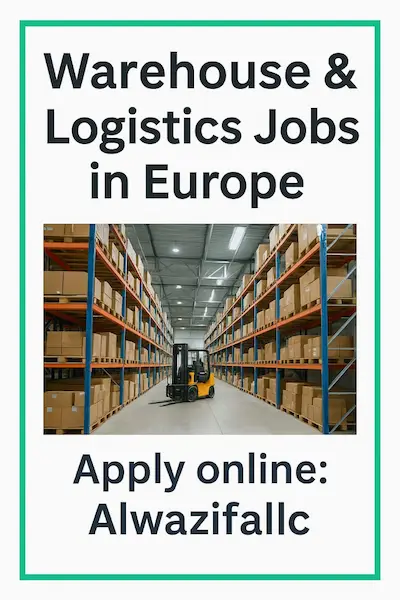
Common Warehouse & Logistics Roles
| Position | Experience Required | Salary (€/Year) |
|---|---|---|
| Forklift Operator | Beginner | 30,000–40,000 |
| Warehouse Supervisor | 2–5 years | 45,000–65,000 |
| Logistics Manager | 5+ years | 70,000–100,000 |
| Delivery Driver | Beginner | 25,000–35,000 |
Some of the benefits are paid vacations, overtime allowances, bonuses, pension schemes, and medical cover.
Employment Prospects for Drivers and Warehouse Personnel
Non-EU citizens need to have a working visa or EU Blue Card whereas EU citizens are free to move. English is generally spoken in the logistics, also, acquiring the local language enhances integration.
Warehouse jobs are stable, have over time work, and promotions. The salaries may be between 50000 and 90000 to skilled staff in large companies.
Denmark has high demand jobs that are open to foreign workers.
Denmark is one of the best places to be offered well-paid jobs. Some of the popular sectors are logistics, warehousing, hospitality, and manufacturing.
Popular Jobs in Denmark
| Job Type | Salary Range (€/Month) | Benefits |
|---|---|---|
| Forklift Truck Driver | 2,500–3,500 | Overtime, Safe Workplace |
| Warehouse Employee | 2,000–3,200 | Paid Holidays, Health Insurance |
| Cleaner / Housekeeping | 1,800–2,500 | Social Protections, Pension |
| Hotel / Restaurant Staff | 2,000–3,000 | Flexible Schedule, Tips |
| Cook / Kitchen Staff | 2,500–3,500 | Training, Career Growth |
In Denmark, work-life balance, high pay, flexible working schedules, and secure workplaces are some of the reasons why it is quite ideal in long-term career advancement.
Work Requirements and Visa Assistance
Most Danish employers assist foreign employees in visa processing, such as:
- Work Visa Program
- Pay Limit Scheme
- Skilled professionals E.U. Blue Card. The language spoken is generally English; the acquisition of simple Danish enhances the integration and earning power.
The reasons why Denmark and Europe are desirable to foreign employees
- Salaries and social protection are high.
- Harmless and organized working conditions.
- Career development prospects in the long-term.
- Excellent work-life balance
- Flexible working hours and paid holidays.
Danmark has a distinct career in logistics, hospitality, manufacturing and facilities management, which is best suited to the ambitious foreign employees.
FAQ – Jobs in Europe
Q1: Are non- EU citizens permitted to work in Europe? Yes, however a proper work visa or EU Blue card will be needed according to country.
Q2: What industries are the most remunerated? Technology, financial and logistics/warehouse positions are the most paid.
Q3: Are the part-time jobs prevalent in Europe? Yes, particularly retail, hospitality and logistics, and flexible schedules are offered.
Q4: are part-time jobs capable of resulting in full-time jobs? Yes, hard working employees are usually promoted to full time or senior jobs.
Q5: What are the best countries in terms of work life balance? France, Germany, Denmark, Netherlands and Sweden are leading nations in terms of moderation of working hours and great vacation.
Conclusion
Europe has good paying, secure, and consistent jobs to skillful and semi-skilled laborers. Logistics, warehouse, hospitality and manufacturing offers great career opportunities, benefits and self developments. You can get your perfect European job, have a cultural exchange, career growth, and a rewarding lifestyle by researching, preparing, and implementing on trusted websites.